

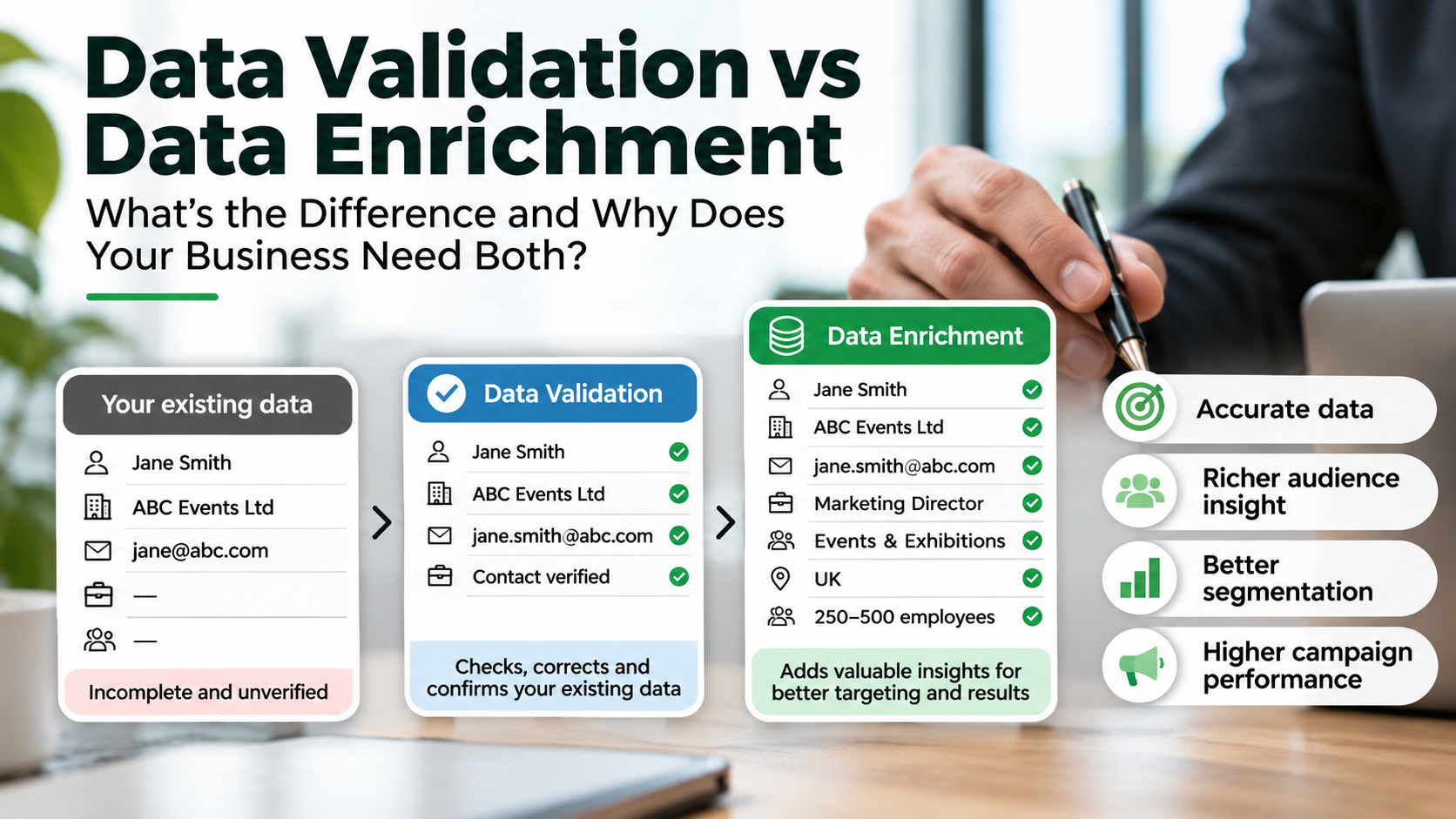
Check accuracy, usability and uncertainty.
Resolve duplicates, errors and inconsistencies.
Add the context needed for useful targeting.
Data validation vs data enrichment is a distinction every B2B marketer should understand: validation checks whether existing information can be trusted; enrichment adds the information needed for useful targeting, segmentation and reporting. Many databases need both, alongside cleansing to resolve the problems identified.
Your database might contain thousands of contacts. But how many of those records can you trust, and how much do you really know about the people behind them?
For B2B marketers, having a large database doesn't necessarily mean having a useful one.
Contact details become outdated. People change jobs. Companies merge, relocate or change direction. Important information such as job function, seniority, industry and organisation size may be missing entirely.
The result is a database that looks substantial on paper but may be holding back your marketing efforts.
Two important processes help address these problems: data validation and data enrichment.
Although the terms are sometimes used interchangeably, they serve different purposes.
Data validation establishes whether your existing information is accurate and reliable. Data enrichment adds or updates the information needed to make that data more useful.
Understanding the difference can help you make better decisions about your database, avoid unnecessary expenditure and build marketing audiences that are genuinely fit for purpose.
Data validation is the process of checking whether the information held in a database is accurate, consistent and suitable for its intended use.
In B2B marketing, validation helps establish whether the organisations and individuals in your database are still relevant, whether contact details are usable and where records require further investigation.
For example, imagine your CRM contains the details of a marketing director at a large exhibition company.
The record might include their name, business email address, company name and telephone number.
At first glance, everything appears complete.
But what if that person left the organisation six months ago?
The information may still look correct because all the required fields are populated. However, it may no longer be useful for contacting the current decision-maker.
This illustrates an important distinction: a complete record is not necessarily an accurate record.
Depending on the type of data and the checks being performed, validation may investigate:
Not all checks provide the same level of assurance. For example, an email address passing technical verification does not prove that its owner still holds the job title recorded in your CRM.
Effective validation needs to consider the purpose for which the information will be used. A catch-all domain or an inconclusive result should remain flagged for review; passing a technical check does not guarantee inbox placement.
Our data validation and cleansing services combine automated checks with specialist investigation where records need closer attention.
These two activities are closely connected, but they are not identical.
Data validation identifies information that needs attention. Data cleansing corrects, standardises, removes or otherwise resolves that information.
For example, validation might identify several records associated with the same organisation, conflicting job titles and an email address that can no longer be verified.
Data cleansing then deals with those issues according to agreed rules.
That might mean merging duplicate records, correcting a company name, standardising fields or flagging information that cannot be resolved confidently.
The distinction matters because identifying a problem is not the same as fixing it.
Data enrichment is the process of adding missing or supplementary information to existing records, and updating information where appropriate, to make a database more valuable for a particular business purpose.
Where validation asks, "Can we trust the information we have?", enrichment asks, "Do we have enough information to use it effectively?"
Imagine a B2B marketing database containing 20,000 contacts.
The records include names, email addresses and organisations, but only a small proportion have information about job seniority, business sector or decision-making responsibilities.
The company could send a broad marketing campaign to everyone in the database.
But it might struggle to distinguish senior decision-makers from operational contacts, group customers by industry or identify which organisations match a particular campaign.
Data enrichment helps fill those gaps.
Depending on the requirements, additional information might include:
For example, enriching a database with reliable job function and organisation-type information could allow a marketing team to create more relevant groups for future campaigns.
Rather than sending the same message to every contact, the business can develop communications around the responsibilities and likely interests of each audience.
The objective is to make information useful for better marketing decisions. Our data management and enrichment service covers the connected work of verifying, completing, organising and maintaining existing records.
| Comparison | Data validation | Data enrichment |
|---|---|---|
| Main purpose | Check accuracy and reliability | Add or update useful information |
| Key question | Is this information correct? | What important information is missing? |
| Typical activity | Verify and assess existing records | Research and append relevant attributes |
| Example | Check whether a contact still works at a company | Identify their current role, seniority or business sector |
| Business benefit | Greater confidence in existing information | Better audience understanding and segmentation |
| Marketing outcome | More dependable campaign data | More relevant targeting and personalisation |
The two processes are complementary.
Validation makes your existing information more dependable. Enrichment makes it more informative.
For many businesses, neither process is sufficient on its own.
Consider a marketing database containing 10,000 B2B contacts.
The marketing team wants to launch a campaign aimed specifically at senior commercial decision-makers in the events industry.
Before starting, it discovers two problems.
First, some records have outdated contact details or refer to people who have changed organisations.
Second, many records lack reliable information about job function, seniority and organisation type.
These are two different data problems.
Validation helps establish which existing records can be trusted and which need further investigation.
Enrichment helps supply missing information so the business can identify and group contacts relevant to its campaign.
Together, they support a database that is both more reliable and more useful.
Illustrative scenario only: the figures below are hypothetical, not The Data Business client results or industry benchmarks.
Suppose the company discovers the following during an initial assessment of its 10,000 records:
These are hypothetical figures, but the situation is familiar to B2B marketers.
The categories may overlap, so the numbers shouldn't simply be added together.
The logical next step is not to purchase another 10,000 contacts.
It is to establish which existing records can be trusted, which can be improved and which audience gaps remain after that work is completed.
That approach helps avoid treating database size as the primary measure of marketing readiness.
Businesses often focus on how many records they hold.
It's an understandable measure because a larger contact database appears to offer a larger marketing opportunity.
But record count tells us very little about the quality or relevance of the audience.
A marketing team might have 50,000 contacts but be unable to answer basic questions:
These questions reveal the limitations of looking at database size alone.
A smaller, well-researched audience may be more useful for a carefully targeted campaign than a much larger collection of poorly understood records.
The real objective is not simply to collect more information.
It is to understand whether the data supports the commercial outcome you're trying to achieve.
The relationship between validation and enrichment becomes particularly important in event marketing.
The following is an illustrative workflow, not a reported client case study.
Consider an exhibition organiser preparing a campaign to attract visitors to an upcoming industry event.
The organiser has accumulated audience data from previous registrations, enquiries, marketing campaigns and event attendance.
Over time, that database has grown substantially.
However, some contacts have changed employers. Others have moved into different roles. Some organisations have merged, and many records are missing the job function or seniority information needed for targeted visitor acquisition.
The organiser now faces a familiar challenge.
How can it reach the right audience when it cannot confidently identify who that audience contains?
Before launching the campaign, the organiser assesses the quality of its database.
Which contact details are still usable? Which records are duplicated? Which organisations remain relevant? Where is information missing or uncertain?
This establishes a clearer starting point.
The organiser investigates questionable records, resolves duplicates and updates inaccurate information where reliable evidence is available.
Records that cannot confidently be verified are identified for further action rather than treated as unquestionably correct.
Next, the organiser researches important missing information.
That may include job responsibilities, seniority, organisation type, sector or other characteristics relevant to the exhibition.
For example, distinguishing procurement directors from operational managers could make it possible to tailor campaign messaging around different priorities.
With more complete, reliable information, the organiser can group its audience more meaningfully.
It might identify existing contacts within priority buyer groups, recognise industries with poor representation or target communications towards people with particular responsibilities.
Even after validation and enrichment, the organiser may discover that some of its desired audience is simply not present in the database.
This is where data building and audience mapping become relevant.
Enrichment improves records that already exist. Bespoke B2B data building helps identify and research the organisations and contacts that are missing altogether. Audience mapping establishes the wider market and can compare it with the organisations already represented in your database. Named contact sourcing is a separate piece of work.
The distinction is commercially important.
You cannot enrich a contact you don't have.
For an event organiser looking to attract new visitors, exhibitors or sponsors, understanding the difference between improving existing data and expanding audience coverage can help shape the entire acquisition strategy.
If your team regularly questions whether a contact still works at a particular company, validation should be a priority.
Outdated information can create unnecessary research work and undermine confidence in campaign preparation.
Unexpected bounces and questionable contact records can indicate problems with data quality.
Technical email validation is useful, but should be combined with wider contact and organisation checks where appropriate.
If important fields such as job function, seniority or industry are missing, enrichment may be needed.
Accurate categorisation gives marketing teams more options for targeted and relevant communications.
When salespeople repeatedly have to investigate job titles, company details or decision-makers before making contact, the database may not be supporting them effectively.
A structured validation and enrichment project can help move that research into a repeatable data management process.
This is a broader audience intelligence problem.
Validation and enrichment improve your existing database, but they don't necessarily tell you how much of your potential market is absent.
Audience mapping can help compare your known audience with the wider market, making it easier to identify gaps and prioritise further research.
A successful project should start with a commercial objective, not simply an instruction to fill every empty field in the CRM.
At The Data Business, the approach centres on understanding what the client is trying to achieve and preparing the data to support that outcome.
The process may involve several connected activities.
Establish who you want to reach, why they matter and what information is required to make the campaign effective.
A campaign targeting senior event marketing professionals will require different information from one targeting specialist insurance brokers.
Identify issues with accuracy, completeness, categorisation and usability.
This helps distinguish records that require correction from those that need additional information.
Check the reliability of existing information, investigate questionable records and resolve data quality problems.
Where a record cannot be confidently verified, uncertainty should be made clear rather than hidden behind an assumed answer.
Research missing fields against the agreed audience requirements.
The priority is meaningful, relevant information rather than collecting attributes simply because they are available.
Organise the data around useful audience groups, including job function, seniority, sector or organisation type.
The resulting records should support your CRM, reporting and campaign requirements.
Once existing data has been assessed and improved, consider whether the database contains enough of the relevant market.
Where important organisations or decision-makers are missing, bespoke data building or market mapping may provide the next step.
Data quality isn't a permanent state.
People move jobs, organisations change and the information needed for marketing evolves.
Regular assessment and maintenance can help prevent the same problems from returning before every campaign. For a fixed launch deadline, our campaign data readiness service brings validation, enrichment, segmentation and suppression review together around the campaign objective.
AI and automated data platforms can play a valuable role in modern data management.
They can help process large datasets, identify inconsistencies, match records, classify organisations and add information from available sources.
However, the quality of the output still matters.
An automated process might return a plausible job title or company category without establishing whether it is correct for the particular individual or business.
A completed field should not automatically be treated as a verified field.
There will also be situations where available sources conflict, where companies have similar names or where a contact's circumstances have changed recently.
These cases require additional investigation and judgement.
At The Data Business, our managed validation and cleansing work combines automated processing with specialist manual review for uncertain, catch-all and higher-risk records where required. The process includes quality assurance and an audit summary, so the output is more than a spreadsheet with extra populated cells.
For teams that want to process their own spreadsheets, Entriq’s self-service data tools offer email validation, organisation classification, job function and seniority classification, and email discovery where available. Managed research is a separate option when the brief needs more investigation or interpretation.
This combination is particularly valuable when a marketing team needs a finished, quality-checked output rather than another software platform to manage.
The question isn't whether automation or human research is better in isolation.
It's whether the overall process produces information the business can use with confidence.
A useful handover should let a marketing manager answer three questions: what changed, what remains uncertain and which audiences can now be selected reliably?
Start with a simple field-level evidence log. For each important attribute, record the source, the date checked, the check performed and the outcome. Keep researched facts separate from inferred classifications. If two sources disagree about a contact’s employer, retain the uncertainty for investigation rather than silently overwriting the record.
For event audiences, agree a classification rule before processing the entire database. A title such as “Director” does not, by itself, establish job function or purchasing authority. Record the underlying job title separately from the standardised function and seniority labels, and review ambiguous titles against the campaign brief.
Use these measures to assess the work:
Define the denominator for each measure. For example, improved validity among retained records does not necessarily mean the number of usable contacts has grown: removing invalid records can increase the percentage while reducing the total. Compare both the rate and the count.
This is a practical project checklist, not a claim that every deliverable is automatically included in every service. Agree the reporting and evidence requirements when the work is scoped.
Improving data quality does not, by itself, give permission to use personal data for marketing. Where B2B records identify individuals, UK GDPR applies and an appropriate lawful basis is required. Public availability does not remove these responsibilities.
Electronic marketing must also satisfy the applicable PECR rules, which depend on the channel and recipient type. Corporate subscribers and sole traders can be treated differently. Keep opt-outs and suppression records effective when refreshing or merging data.
See the ICO’s business-to-business marketing guidance for the relevant distinctions. The ICO currently flags this guidance as under review following legislative changes; check the latest version when planning activity.
Usually, establish a reliable starting point before paying to enrich records. Resolve duplicates and uncertain identity matches first, then validate any newly added contact information. Some checks will run iteratively as research reveals new information.
No. Cleansing resolves problems such as duplicate records, inconsistent formatting and inaccurate fields. Enrichment adds relevant information that is missing or insufficient. A project can involve both, but the activities should have separate acceptance criteria.
No. An address may pass technical checks while the job title, employer or responsibilities in your CRM are outdated. Identity, role relevance and technical email status are different checks.
Set the review frequency around how quickly the audience changes and when the data will be used. Event organisers may review visitor data ahead of campaign launch and process registrations after an event, with new records checked as they arrive. There is no single interval that suits every database.
Enrichment improves the records you hold. Understanding which relevant organisations are absent requires a wider market definition and comparison, typically through audience mapping. Researching named contacts in those organisations is then a data-building task.
Data validation helps you assess what can be trusted. Data cleansing resolves the problems found. Data enrichment supplies the context needed to understand and segment your audience. Audience mapping and bespoke data building address the market you have yet to reach.
The best starting point is the commercial objective: who you need to reach, what you need to know about them and when the campaign must be ready.
Tell The Data Business what you are working towards and what data you already hold. We can discuss whether validation, cleansing, enrichment or a wider audience review is the right next step.